

Ontario Noise Regulations: 2026–2027 MLITSD Inspection Campaign

Speak with an Occupational Hygienist
Ontario’s Ministry of Labour, Immigration, Training and Skills Development (MLITSD) has released its 2026-2027 health and safety compliance campaign priorities, confirming the hazards and workplace conditions inspectors will focus on during inspections until March 31, 2027.
This year’s campaigns includes many different focus areas. One area of focus all employers should not overlook is occupational noise exposure.
Is your workplace prepared?
Until March 31, 2027, MLITSD health and safety inspectors will conduct proactive inspections in workplaces where workers may be exposed to noise. They will evaluate compliance with Ontario’s Noise Regulation, O. Reg. 381.
Could your workplace answer “yes” to each of these questions
- Have worker noise exposure levels been adequately evaluated?
- Are workers protected from exposure above the limit of 85 dBA Lex,8?
- Have engineering controls and work practices been considered before relying on hearing protection?
- Are hearing protection devices appropriate for the exposure and working conditions?
- Have workers received adequate training in the care and use of hearing protection?
- Are warning signs posted at every approach to areas where sound levels regularly exceed 85 dBA?
The campaign does not mean every workplace automatically requires a new noise assessment. However, employers should be able to demonstrate how they evaluated exposure and determined that their controls are adequate.
Is noise a problem in your workplace?
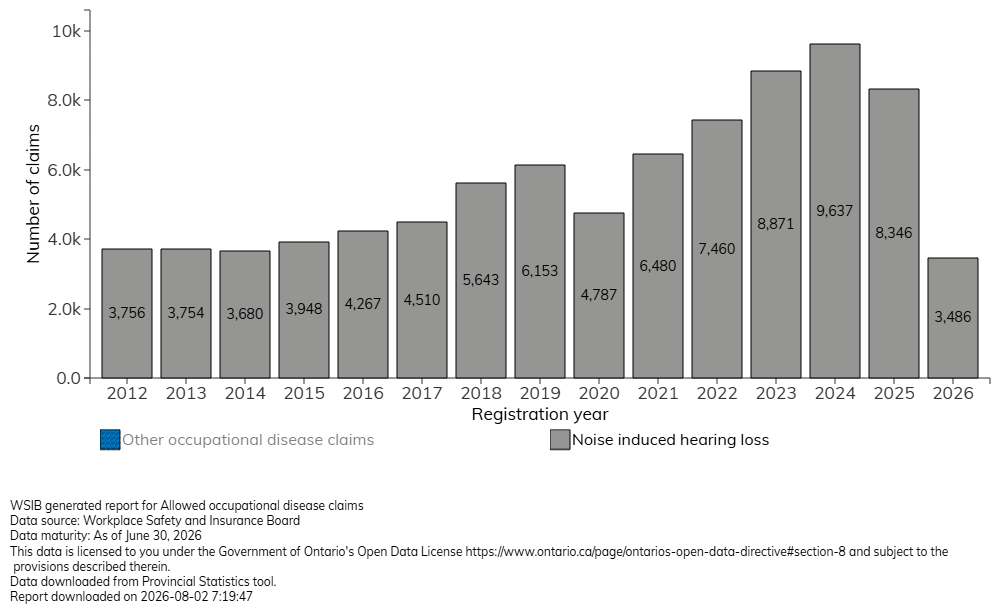
According to WSIB Safety Check data, more than 66,000 noise-induced hearing loss claims were approved by the Workplace Safety and Insurance Board (WSIB) from 2016 to 2025. Over recent years, the number has escalated significantly.
This is one of the main reasons why noise is part of this year’s health and safety enforcement campaign.
The Ministry has identified four principle areas of focus for its noise campaign
1. Worker noise exposure
Employers should be prepared to explain how much noise workers are exposed to. Ontario’s Noise regulation limits worker exposure to an equivalent sound exposure level of 85 dBA over an eight-hour workday, commonly expressed as 85 dBA Lex,8.
This is not a short, instantaneous measurement taken at one point in a shift beside a machine.
Instead, Lex,8 is a type of average noise exposure (logarithmic) a worker is exposed to over the course of a work day. It is best captured using a personal noise dosimeter that measures incorporates two important factors:
- Sound levels produced by different tasks and equipment
- The amount of time spent exposed to different noise levels.
Measuring sound at only a few points in a work shift can be misleading and not provide a real depiction of risk. This is like trying to measure a rollercoaster’s average speed with a radar gun at one point on the track. You’ll miss every hill and drop that actually matters.
For companies that have carried out a noise survey in the past, those results should be reviewed to confirm that they are still valid. See FAQs.

2. Engineering Controls and Work Practices
Health and safety inspectors will be examining workplaces to determine if employers have considered ways to reduce noise levels before hearing protection is used by workers.
A few ways to reduce noise:
- reduce the drop height of equipment
- erect barriers, enclosures or acoustic treatment
- ensure equipment is maintained
- dampen impact points
- move loud sources of noise away from workers
- plus more.
Hearing protection may still be necessary. However, if your workplace expects workers to use earplugs or earmuffs, it should be prepared to show an inspector what other measures were considered and why they were not implemented.

3. Hearing Protection and Training
MLITSD health and safety inspectors may evaluate how hearing protection devices are selected, used and maintained.
Issues that may get flagged include:
- Workers not using ear plugs or muffs in loud environments.
- The type of hearing protection device used does not seem to be protective enough.
- The ear plug or muff is not compatible with other types of personal protective equipment (PPE).
- Hearing protection devices are dirty, broken, or not maintained properly.
- Workers have not been instructed and trained on the use of hearing protection devices. See FAQs for topics that must be covered in training.

WorkBright helped our health and safety team with an occupational hygiene assessment. Mike communicated effectively and prepared our team for the day. His findings were thorough and clear to understand which gave us and our employees confidence. We truly value his expertise.
4. Warning signs
Warning signs must be posted at every approach to an area where sound levels regularly exceed 85 dBA.
Employers should confirm that signs are:
- Posted at all entrances to work areas where noise is problematic.
- Understood by employees, contractors and visitors. Consider visual illustrations and different languages in the workplace.
Frequently asked questions about Ontario noise regulations
What is Ontario’s workplace noise exposure limit?
Ontario’s Noise Regulation limits worker exposure to an equivalent sound exposure level of 85 dBA over an eight-hour workday, expressed as 85 dBA Lex,8.
Does every Ontario workplace require a noise assessment?
Not automatically. Employers must ensure workers are not exposed above the regulatory limit. An assessment may be warranted when exposure has never been adequately evaluated, workplace conditions have changed or existing information is insufficient to establish compliance.
Our workplace had a noise assessment carried out a while ago. Is it still valid?
A past noise assessment may still be useful when workplace conditions have not changed. Over time, new equipment could be added, some equipment could have been removed, more workers or fewer workers may be present in the workplace now, and several other noise exposure factors could have changed since, making it important to have noise reassessed.
When might you need a noise exposure assessment?
- You received a notice from the WSIB about a hearing loss claim filed by an employee of your company.
- A health and safety inspector with the MLITSD has issued your workplace an order to have a noise assessment carried out.
- Hearing protection is used.
- Operating conditions have changed. This could include a new layout, productivity increases or other factors that can increase noise levels.
Is providing hearing protection enough?
The Noise Regulation (O.Reg. 381) and MLITSD campaign emphasize that workplaces must consider engineering controls and work practices to reduce noise exposure before hearing protection is used.
What must worker training include?
Employers are required to provide instruction and training to workers who use hearing protection devices. Instruction and training must include, at a minimum:
- care and use of the device,
- limitations,
- proper fitting,
- inspection and maintenance and,
- if applicable, the cleaning and disinfection of the device.
When are warning signs required?
Warning signs must be posted at every approach to an area where sound levels regularly exceed 85 dBA. This includes entrances used by workers, contractors, and visitors.
Final Thoughts
The 2026–2027 MLITSD health and safety enforcement campaign places increased attention on how Ontario employers evaluate and control workplace noise.
Having hearing protection available is only one part of compliance. Employers should also be able to demonstrate that noise exposure has been properly evaluated, engineering controls and work practices have been considered, workers are trained and required warning signs are posted.
Where existing information is absent, outdated or does not represent current operations, workplace noise screening or a formal exposure assessment may be appropriate.
WorkBright conducts workplace noise assessments throughout Ontario, including sound-level screening, personal noise dosimetry and practical control recommendations.
More articles

Health and Safety Compliance in Ontario: What Inspectors Enforce
In 2024, Ontario inspectors issued over 88,000 health and safety compliance orders to workplaces. We analyzed every one to reveal which laws were most cited and where compliance gaps are most common. Explore the interactive tool to see the top 5 orders for your sector.

Occupational Exposure Limits Ontario: What Employers Must Do to Comply
Occupational Exposure Limits (OELs) are critical for protecting workers from harmful exposures to chemicals, noise, and other hazards. This guide explains how OELs work, outlines key Ontario regulations like Reg. 833 and 381, and highlights how employers can stay compliant while keeping workers safe.
3 Tips for Protecting Workers from Noise Exposure and Complying with the Law
Noise-induced hearing loss remains one of the most common occupational diseases in Ontario. This article shares three practical tips to help workplaces assess noise risks, reduce exposure, and meet legal requirements — all while protecting worker health and productivity.